Timeline of Juneteenth and my research about slavery
By Albert Don Henderson, July 3, 2021 (Update May 31, 2024)UPDATE: JUNE 12, 2025
I personally think Slavery of Any Kind, Anywhere was and is a horrible thing. I just want to set that record straight. The Civil war was a terrible time in our history, but I believe it was about power and not about slaves. The following is my findings about Juneteenth and why I believe it was not the proper date to be chosen. I have no real objection to choosing this date, other than it is Not the date when slaves were actually freed.
Lincoln was faced with opposition on more than one front concerning slavery. The abolitionists looked at the war as a way of ending slavery and resented Lincoln for not moving faster. At the same time there was an equally large anti-abolitionist group, so the Republican cabinet was divided. Some of the Union Generals began freeing slaves and one of the generals, General Fremont proclaimed slaves free in Missouri. Lincoln asked Fremont privately to withdraw his proclamation and when he refused, Lincoln relieved him of his duties.
In May 1862, another general, General Hunter did the same thing Fremont had done and declared all slaves in Georgia, Florida, and Louisiana forever free. Lincoln quickly responded, “no commanding general shall do no such thing…without consulting me.” He declared Hunter’s proclamation void. Lincoln said, “The commander and chief can issue such orders, but not a general in the field.” Lincoln was able to keep slavery in the background at the beginning of the war, but eventually he could no longer do so. He was facing an anti-slavery group as well as the pro-slavery group and he could no longer ignore either. Lincoln wanted to preserve the union as his primary concern and if he had to free the slaves to save the union, or if he had to keep slavery, which ever he supported his main aim was to save the union.
Horace Greeley originally urged the country to let the southern states go in peace, but in August of 1862 in an open letter to President Lincoln called “The Prayer of Twenty Millions”. https://collections.americanantiquarian.org/freedmen/Manuscripts/greeley.htmlGreeley felt if the rebellion was crushed and slavery was left, the rebellion would be renewed soon after. Greeley recognized many of the Union generals were pro slavery and an equal number were anti-slavery.
Lincoln’s reply:
“My ultimate object is to save the Union, not to save or destroy slavery. If I could save the Union without freeing any slave, I would do it; if I could save it by freeing all slaves, I would do it; and if I could save it by freeing some and leaving others alone, I would do that also.”
Lincoln as a private citizen was a conservative lawyer and recognized the legality of the owner’s title to the slaves. He felt this could not be arbitrarily ignored. He suggested a gradual abolishment of slavery and the state would pay for every slave at the rate of $400 each, but some states refused to take advantage of it. He tried a 2nd time in a message, December 1862, he wanted congress to adopt an amendment to the Constitution, allowing compensation to any state which would abolish slavery at any time prior to January 1, 1900. He suggested the long period would give both the slaves and the owners a chance to adjust. This would save the slaves from destitution. Congress unanimously disapproved and the idea of compensation dropped out of the picture.
After failure with the payment plan, Lincoln decided to proceed against slavery using his war power as president. He planned to announce freedom of all slaves in parts of the country where rebellion still existed. The first draft of the proclamation was written in July 1862. Lincoln showed his proclamation to his Cabinet after congress had adjourned and Seward suggested waiting until after a military victory for the Union before making a public announcement of this proclamation. Lincoln issued his proclamation after McClellan had succeeded in checking Lee’s progress at Antietam. The following are two links to one of the bloodiest battles in history.
https://www.battlefields.org/learn/civil-war/battles/antietam
https://en.wikipedia.org/wiki/Battle_of_Antietam
It was to go into effect January 1, 1863. The following statement contained the basics of the proclamation: “All persons held as slaves within any state or designated part of a state the people whereof shall be in rebellion against the United States shall be then, thenceforward, and forever free.”
This Proclamation, called the Emancipation Proclamation, did not emancipate a single slave. Lincoln’s famous document was not designed to free the slaves, but was only a military measure, which had No constitutional or legal justification. In December of 1863, a member of Congress introduced the Thirteenth Amendment to the Constitution, which provided for complete an absolute abolishment of slavery everywhere within the jurisdiction of the United States. This Amendment DID NOT win the approval of Congress until January 1865. The following December of 1865 the Amendment was ratified by ¾ of the state legislators and put into effect.
Politics during the War were on all sides of the aisle, some supporting Lincoln, some opposed to his agenda and war efforts as well as other divisive elements that hindered what Lincoln was trying to do………SAVE THE UNION. Lincoln ordered the suspension of habeas corpus (by definition, if a person was arrested, that person has the right to appear before a judge, but if suspended, a person could be arrested and go directly to jail without appearing before a judge) and disloyal citizens were arrested. This meant that those disloyal could be arrested without appearing before a judge; however, if was a member of congress, they would not be suppressed from their views. Among the various factions there were the Pro-Confederates, elements objecting to “war” in general based on ethical or religious convictions. Another groups the “Copperheads” were openly sympathetic to the Confederacy. Lincoln felt it was his duty (as he saw it) to preserve, by any means, the Nation, and the Constitution. To ensure the safety of the state, it required incarceration of many citizens designated as disloyal. “Disloyalty” meant jail for many prominent Democrats and as many as 13,000 citizens were arbitrarily arrested and placed in jail to protect the state.
Timeline of events leading up to Juneteenth
- Aug 1862– Lincoln tried to get congress to enact a law providing for the state to pay $400 for every slave and then the state would own them and could free them, but the act failed
- 2nd Dec 1862 Lincoln, still trying to resolve the slavery issue, wanted congress to abolish slavery at any time prior to 1900, giving the slaves and the owners time to work out issues. It was Lincoln’s thought that to free the slaves all at once would be a hardship on them in ways such as, they owned nothing, had no skills and had never lived without someone caring for them. Congress rejected this.
- July 1862 1st draft of the Emancipation Proclamation, A member of his cabinet, Seward, suggested that this proclamation not be publicly announced until there was a major military victory. On September 22, McClellan claimed a major victory by checking Lee’s progress at Antietam.
- Jan 1 1863 Emancipation Proclamation went into effect and was publicly announced after McClellan’s success. Even though announced as THE EMANCIPATION PROCLAMATION, it had no legal status. Lincoln was using his war powers as President and head of the Army, he could issue the proclamation, but only in state where there was a war effort going on and where there was still rebellion.
- Jan. 1865 the 13th amendment was approved by congress,
- December 1865 the 13th amendment was ratified by ¾ of the legislators and put into effect. Absolute abolishment of slavery everywhere under the jurisdiction of the United States
The 13th Amendment
Section 1. Neither slavery nor involuntary servitude, except as a punishment for crime where of the party shall have been duly convicted, shall exist within the United States, or any place subject to their jurisdiction.
Section 2. Congress shall have power to enforce this article by appropriate legislation
The 13th amendment was not politically popular at the time. Lincoln faced varying views. On the one hand, those wanting immediate abolition and those who viewed saving the Union above all. During this time and suspension of habeas corpus, many dissidents were arrested.
After being ratified, word apparently had not reached Texas until Major General Granger delivered the announcement in Galveston, Texas, June 19th, 1865. A copy of the original announcement and the generals orders is provided below. The General also provided a handwritten note. See the announcement and the note below. Source: The National Archives
June 19th of 1865, referred to as Juneteenth, was an announcement in Galveston, Texas declaring the freedom of slaves in Texas.
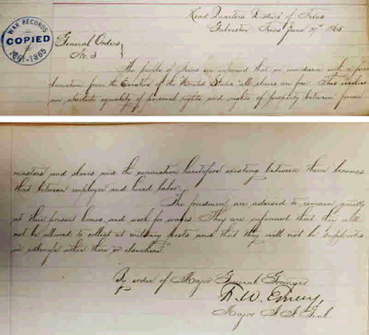
This is the transcribed version of the letter by the general.
“The people of Texas are informed that, in accordance with a proclamation from the Executive of the United States, all slaves are free. This involves an absolute equality of personal rights and rights of property between former masters and slaves, and the connection heretofore existing between them becomes that between employer and hired labor. The freedmen are advised to remain quietly at their present homes and work for wages. They are informed that they will not be allowed to collect at military posts and that they will not be supported in idleness either there or elsewhere
By H.W. Emery, Major General
Ordered by General Gordon Granger
Note: Texas appears to be the last state to be informed of the freedom of the slaves, but although the letter says all slaves are free, they were advised to remain quietly at their present homes and work for wages and they will not be allowed to collect at military post and they will not be supported in idleness.
My question is: “Ok, so it was posted in Galveston. How many slaves could read at this time. How was word to get to the rest of Texas? Since the June 19th Proclamation only freed slaves in Texas, why choose June 19th as the day to celebrate a National holiday. It seems to me, the more appropriate date would be when the 13th amendment was ratified, which was December of 1865. This is when the constitutional amendment was ratified. I have no problem that June 19th was selected, but it just seems to me, this was a time only to free Texas slaves and NOT ALL. The 13th amendment, not June 19th, not the Emancipation Proclamation, was the one which freed the slaves.
My research has come mainly from my college history book: THE UNITED STATES: From Wilderness to World Power, revised edition. Copyright 1953 by Henry Holt and Company. In addition, I used the National Archives
My teacher for History was Victor Lewis at Henderson County Junior College (Now Trinity Valley), where if you enjoyed stories, not related to any history lesson to be tested on, but interesting stories told by Vic Lewis, you would have thoroughly enjoyed his class. Be warned, you best better read the book if you wanted to pass his test. His lectures, though interesting, would give you no clue to the forth coming test.

Leave a Reply